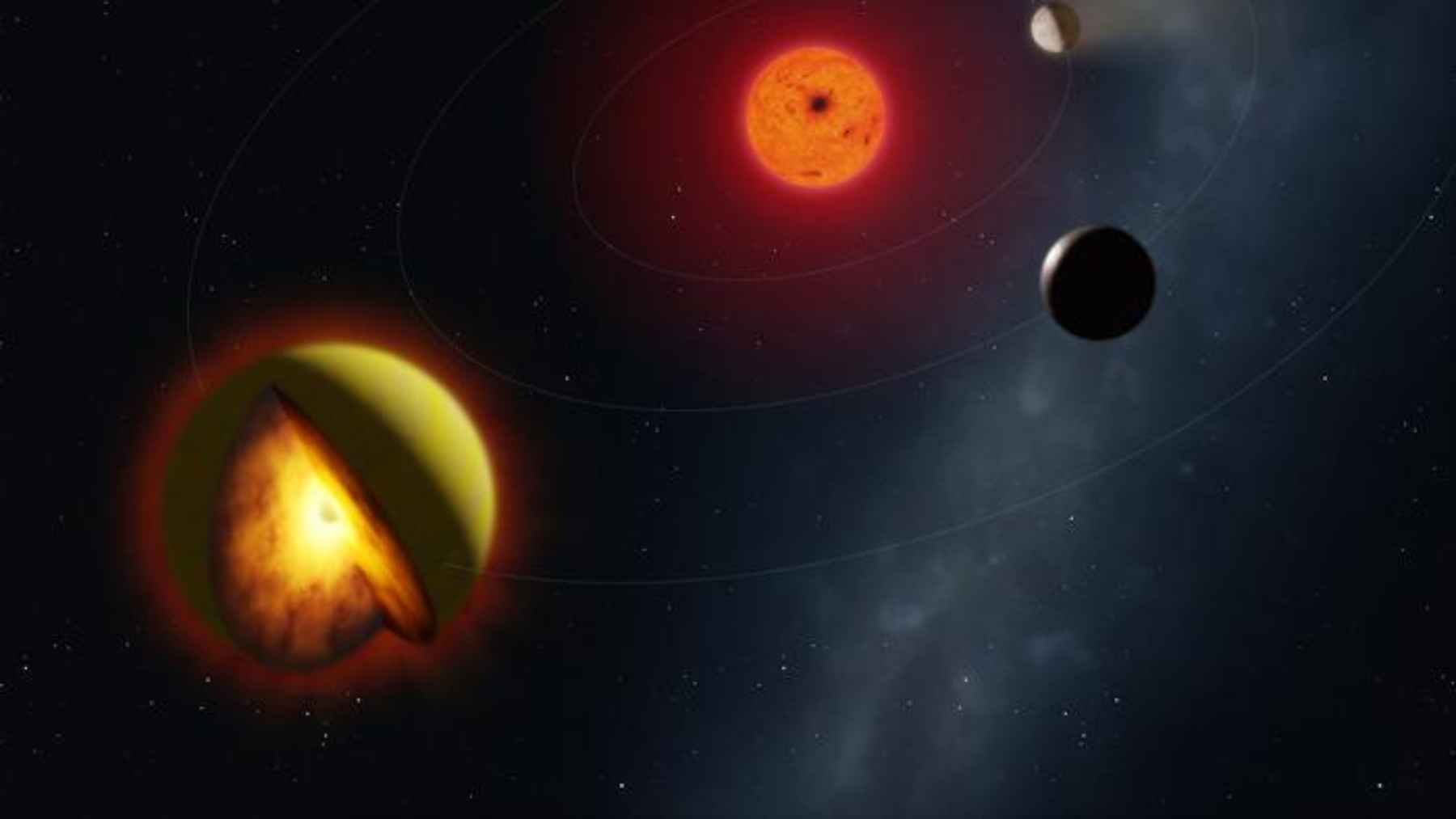
Astronomers led by the University of Oxford say they have identified an exoplanet that does not fit the usual labels. In a peer-reviewed study published March 16, 2026 in Nature Astronomy, the team argues that L 98-59 d hides huge sulfur reserves inside a long-lasting global ocean of molten rock, which can help keep its atmosphere in place for billions of years.
The planet orbits a small red dwarf about 35 light years away (roughly 206 trillion miles), and it is about 1.6 times Earth’s radius (around 6,400 miles). How do you figure out what is inside a world you will never visit?
A sulfur-rich planet with a permanent magma ocean
L 98-59 d is called a “super-Earth” because of its size, but its interior may be anything but Earth-like. Measurements put it at about 1.64 Earth masses and 1.627 Earth radii, with an unusually low density.
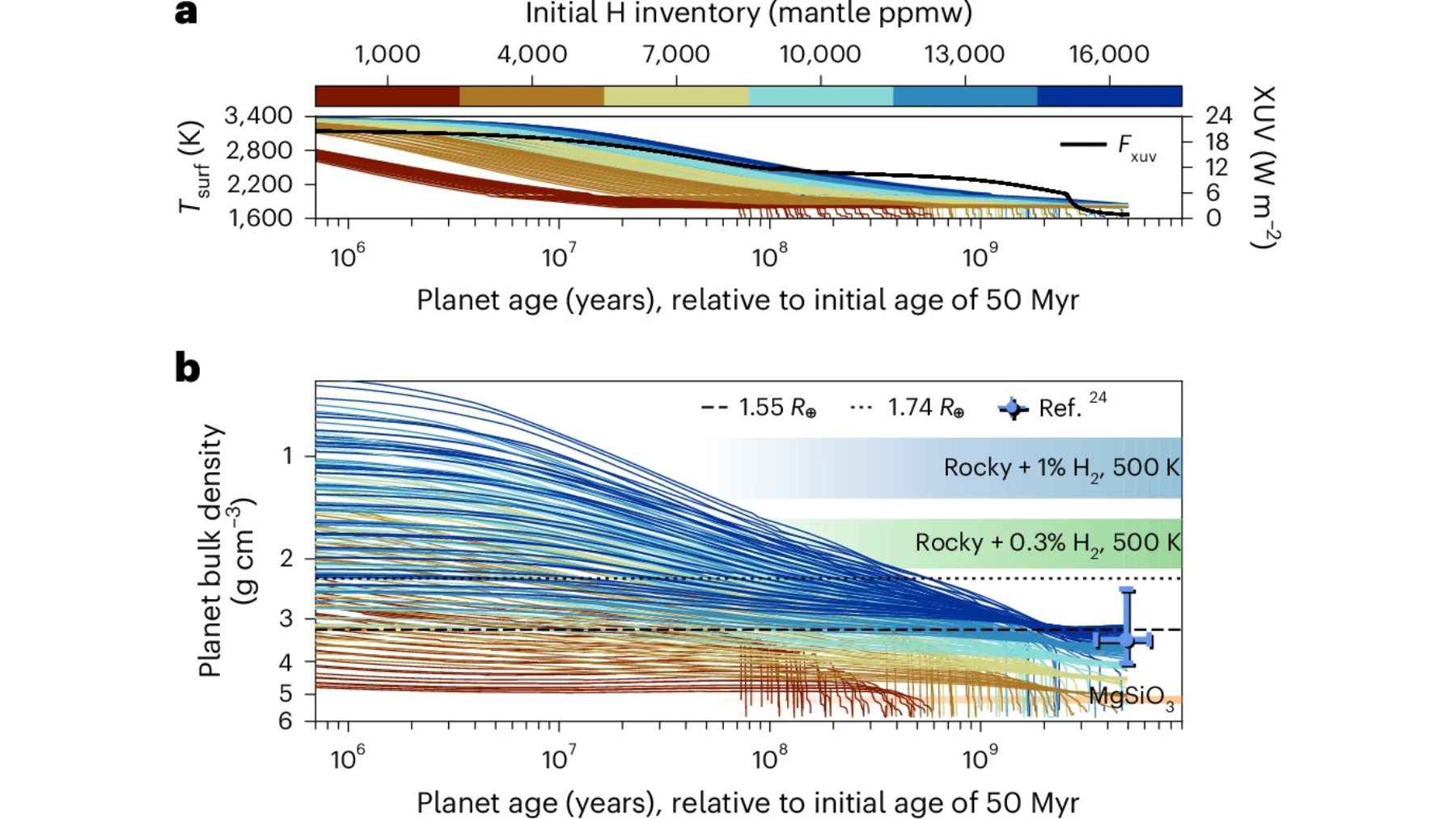
One estimate puts its density at 2.2 grams per cubic centimeter (about 137 pounds per cubic foot), while another analysis explored in the paper uses 3.45 grams per cubic centimeter (about 215 pounds per cubic foot).
Either way, the numbers point to a planet puffier than a simple rock and iron mix would allow. Many low density small planets get described as a rocky core wrapped in hydrogen, or as a water rich “ocean planet.” The Oxford-led team says L 98-59 d looks different, with a hydrogen background carrying sulfur bearing gases like hydrogen sulfide (H2S) and sulfur dioxide (SO2).
The key idea is a permanent magma ocean, a mantle made of silicate melt on a global scale that could extend thousands of kilometers downward (well over 600 miles). Molten rock can dissolve and store volatiles, so it can act like a slow release tank for sulfur over geologic time.
Lead author Harrison Nicholls said, “This discovery suggests that the categories that astronomers currently use to describe small planets could be too simplistic.”
What JWST saw and what it could not see
JWST cannot image the planet’s surface, but it can measure how starlight filters through its atmosphere during a transit. Those tiny changes in light carry the fingerprints of gases, and JWST observations in 2024 hinted at SO2 along with other sulfur species in the upper atmosphere.
The researchers then used coupled atmosphere and interior simulations that track the planet’s evolution from a molten start to the present day over nearly five billion years. In their models, it formed volatile-rich, with more than 1.8 percent of its mass in atmosphere forming volatiles, and it cooled and shrank without fully solidifying.
The result is a planet that can keep a thick atmosphere even under strong stellar radiation that would normally strip light gases away.
Professor Raymond Pierrehumbert, a coauthor, summed up the approach when he said, “It’s exciting that we can use computer models to uncover the hidden interior of a planet that we will never visit.” The story is not guaranteed, but it is built to match telescope measurements.
Photochemistry makes sulfur dioxide in the sky
The study also explains why SO2 shows up at high altitudes even if it is not the main gas rising from the surface. In the team’s scenario, ultraviolet light from the host star drives photochemical reactions that can convert sulfur gases into SO2 higher up, where radiation is strongest.
That chemistry likely depends on water vapor, because water can create reactive OH radicals when it is split by starlight. Water is still poorly constrained in the current spectrum, partly because its absorption overlaps with other features, so the paper flags this as a key test for future observations.
Richard Chatterjee, another coauthor, noted the most down to earth detail in an otherwise alien atmosphere when he said, “The hydrogen sulfide, responsible for the smell of rotten eggs, seems to play a fundamental role.” Are sulfur rich magma ocean planets common, or did JWST just hand us a rare oddball?
A greenhouse lesson from a world that never cooled
No one is presenting L 98-59 d as a place for life, at least not as we understand it. The same models that match its low density also keep its interior partly molten today, with one case study retaining surface pressures around 30 kilobars (about 435,000 pounds per square inch).
The modeled surface cooled from roughly 3,360 kelvin (about 5,588 degrees Fahrenheit) to about 1,830 kelvin (around 2,834 degrees Fahrenheit) over its early evolution, which is still blisteringly hot.
Still, extreme planets can teach useful physics. Magma oceans are thought to be an early stage for rocky planets, including Earth and Mars, so learning how sulfur, hydrogen, and water move between melt and air helps scientists model how atmospheres begin and survive. It is the same greenhouse logic behind sticky summer heat and the electric bill.
The work also matters for classification, because a planet’s size can change over time. In the models, L 98-59 d could have had an effective radius larger than 2.2 Earth radii early on (a radius over 8,700 miles) before cooling and atmospheric loss shrank it toward the “super-Earth” side of the so called “radius valley.”
That means a planet can look like one type of world in a survey and slowly evolve into something else.
The next step in the hunt for livable worlds
The team says JWST is only the beginning, with more exoplanet data expected from upcoming missions such as Ariel and PLATO. They plan to apply similar simulations, increasingly with machine learning, to map the diversity of small planets and connect atmospheric fingerprints to interior states.
For everyone else, the takeaway is straightforward. Sulfur signals like SO2 and H2S might not just be atmospheric trivia, they can be the smoke from a deep molten fire that changes how a planet keeps its air.
The study was published on Nature Astronomy.