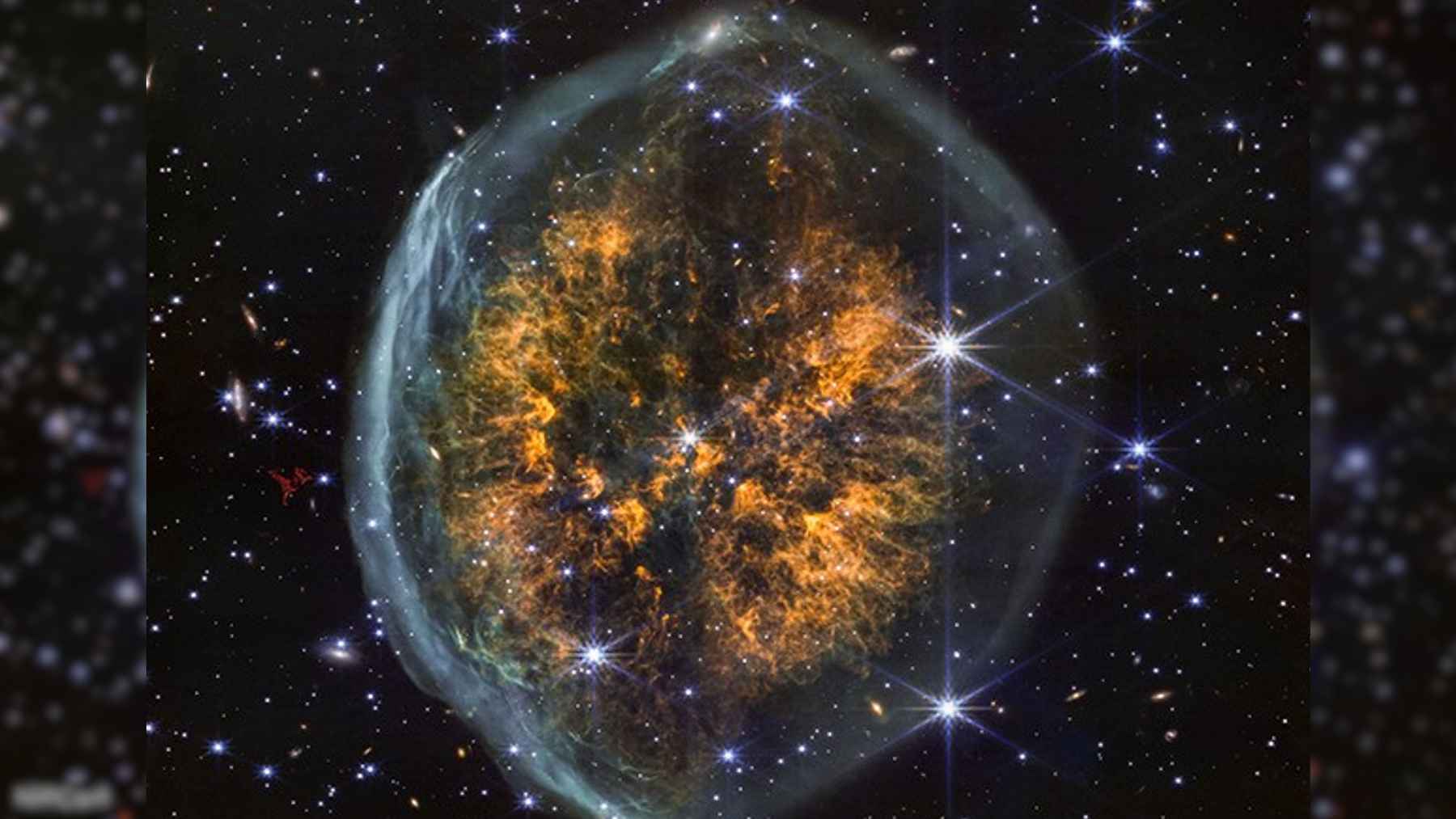
At first glance, it looks like a transparent skull drifting through deep space. But NASA’s new James Webb Space Telescope images show that PMR 1, nicknamed the “Exposed Cranium” nebula, is really a planetary nebula about 5,000 light-years away in the constellation Vela, formed by a star nearing the end of its fuel-burning life.
The real story goes beyond the eerie shape. By combining near-infrared and mid-infrared views from Webb’s NIRCam and MIRI instruments, astronomers can separate where stars and background galaxies shine through from where cosmic dust glows more strongly, almost like a cosmic scan of a star coming apart in layers.
Why PMR 1 looks so strange
NASA released the new side-by-side views of PMR 1 on February 25, 2026, using Webb observations taken on March 30 and 31, 2025. The object itself is not huge by nebula standards, with the image covering about 3.2 light-years across, but Webb’s sharper resolution makes its strange symmetry much harder to ignore.
That skull-like look is not new, at least not entirely. PMR 1 was first revealed in infrared light by NASA’s Spitzer Space Telescope more than a decade ago, but Webb now shows much finer detail, including the vertical dark lane that splits the object into two brain-like halves.
Why does the same nebula seem to change face from one panel to the other? In the NIRCam view, the outer bubble has a bright white edge and orange inner clouds, while stars and distant galaxies remain visible through much of the scene.
In the MIRI image, the outer shell shifts to a bluish glow and the inner regions look denser and more ivory-toned because dust stands out far more clearly there.
A planetary nebula caught in transition
So what is Webb really showing us here? According to NASA, PMR 1 has at least two clearly different regions, including an outer shell made mostly of hydrogen that was blown off earlier and a more structured inner cloud filled with a mix of gases.
In practical terms, that means the telescope is not just photographing a pretty cloud. To a large extent, it is showing separate stages of the same star’s decline, with the smoother outer bubble marking earlier mass loss and the tangled interior tracing a later and more complicated phase.
This phase is brief by cosmic standards. NASA describes it as a dynamic and fairly fast process, with the dying star throwing off its outer layers while Webb catches only one moment in that long, fading goodbye.
The dark lane may be the biggest clue
The feature that pulls the eye right away is the dark stripe running vertically through the center. Webb’s resolution suggests that this lane may be linked to an outburst or outflow from the central star, the kind of event that often appears as twin jets pushing material in opposite directions.
The strongest hint appears near the top of the MIRI image, where the inner gas seems to be pushing outward, with a weaker echo at the bottom.
Is that the final answer? Not yet, because NASA says there is still much to learn about PMR 1, but the dark lane is one of the clearest clues that repeated ejections helped sculpt its unsettling shape.
What happens to this star now
That part depends on something astronomers still do not know with precision, which is the mass of the central star. If it turns out to be massive enough, the story could end in a supernova, but if it is more like a lower-mass Sun-like star, it will keep shedding material until only a dense white dwarf core remains and cools for eons.
And that is why PMR 1 matters. It is the kind of image that grabs attention because it resembles a skull, but it keeps scientists looking because it offers a rare close view of how dying stars shape gas and dust into complex structures that are still not fully understood.
The official release was published on NASA.